• Project Update | Discover JinMega’s BIPV Solution at Yinggehai Salt Field in Hainan

    We’re excited to share the successful completion of JinMega’s 11.49 MW BIPV Solar Mounting Solution at Yinggehai Salt Field, the largest salt field in southern China. This project was seamlessly connected to the grid in 2024, marking another milestone in our mission to deliver high-performance renewable energy solutions.


    BIPV Solar Mounting Solution


    Our BIPV solution is built for performance, offering durability with high-strength aluminum, fast 3-step installation, easy maintenance to reduce downtime, and eco-friendly features that enhance natural lighting and ventilation.


    Explore how BIPV transforms rooftops into sustainable energy assets here

  • How to Achieve Energy Independence with Home Energy Storage Systems

    As global attention on sustainable energy continues to grow, home energy storage systems (ESS) have become an ideal choice for more and more households to achieve energy independence. When combined with solar power, home energy storage systems not only effectively reduce reliance on the power grid but also save on electricity costs, improve energy efficiency, and contribute to environmental protection. 


    What is a Home Energy Storage System?

    A home energy storage system is an efficient device that stores and manages electricity for the household, usually used in conjunction with a solar power system. Solar panels convert sunlight into electricity, and when the energy produced exceeds the household's demand, the excess power is stored in a storage battery. When electricity demand exceeds solar generation, the stored energy is released, ensuring the household's energy self-sufficiency.


    This system can effectively reduce a household’s reliance on the external power grid, providing a more flexible and efficient power usage solution and making it an effective tool for achieving energy independence.


    Main Advantages of Home Energy Storage Systems

    1. Backup Power Supply

    In the event of a power outage or unstable power supply, a home energy storage system can provide backup power, ensuring the normal operation of household devices. Especially during high power demand periods, the storage system can ensure continuous power for daily household needs, avoiding the inconvenience caused by power outages.


    Additionally, when combined with solar power generation, the home energy storage system can operate off-grid, further reducing dependence on the power grid.


    2. Suitable for 99% of Traditional Household Appliances

    Home energy storage systems come in a variety of power models, making them suitable for a range of traditional household appliances. Whether it's kitchen appliances, televisions, air conditioners, or power tools, the storage system can meet the household's energy needs. Depending on electricity consumption, users can choose an appropriate storage system to ensure that household devices operate normally under all circumstances.


    3. Electric Vehicle Charging Support

    With the increasing popularity of electric vehicles, many households have started using electric cars for daily transportation. Home energy storage systems support electric vehicle charging, providing clean energy to charge electric cars and reducing dependence on public charging facilities. By utilizing solar power generation and storage systems, households can charge their electric vehicles more economically and environmentally.


    4. Integration with Solar Power Systems

    Home energy storage systems are typically used in combination with solar power systems to maximize solar energy utilization. These systems integrate technologies such as inverters, battery management systems (BMS), Wi-Fi, and RS485 modules to ensure efficient power management. During the day, the electricity generated by solar power is used by the household, and any excess is stored in the storage battery. At night or on cloudy days, the stored energy is released to ensure stable electricity for the household.


    Moreover, home energy storage systems can serve as a backup power supply when the grid is insufficient, preventing inconvenience due to power shortages.


    Working Principles of Home Energy Storage Systems

    The working principle of a home energy storage system is simple yet efficient and mainly involves the following steps:


    Solar Power Generation: Solar panels convert sunlight into direct current (DC) electricity for household use.


    Power Conversion: An inverter converts DC electricity into alternating current (AC) electricity for household appliances.


    Energy Storage: Excess electricity is stored in the storage battery through the inverter. Once the battery is full, the remaining power is kept as backup to ensure future demand is met.


    Intelligent Management: Modern home energy storage systems are typically equipped with intelligent energy management systems (EMS) that can monitor the generation, storage, and usage of electricity in real-time. These systems automatically adjust the battery’s charge and discharge cycles to ensure optimal utilization of electricity.


    With technological advancements, some systems have evolved into Intelligent Energy Storage Systems, which, through more intelligent management and monitoring, enhance overall efficiency and operational convenience.


    How to Choose the Right Home Energy Storage System?

    Selecting the right home energy storage system is crucial for achieving energy independence. Here are some important factors to consider when choosing a system:


    1. Storage Capacity

    Storage capacity is one of the most important factors when choosing a home energy storage system. The capacity of the storage system should be selected based on the household's electricity needs. If the household generates a significant amount of solar energy during the day, the stored power will support energy usage during the evening or on cloudy days, ensuring no reliance on the grid.


    2. Battery Type

    Currently, there are two common types of storage batteries in the market: lead-acid batteries and lithium-ion batteries. Lithium-ion batteries have higher energy density, longer lifespan, and better charge/discharge efficiency, making them the mainstream choice for home energy storage systems. Although the initial investment is higher, lithium-ion batteries offer better cost-effectiveness in the long run.


    3. Compatibility with Solar Power Systems

    Ensuring that the storage system is compatible with the existing solar power system is a key factor when choosing a system. Many Solar Energy Storage Systems are compatible with different brands of solar panels and inverters, ensuring the system's stability and reliability.


    4. Intelligent Energy Management

    Choosing a storage system equipped with an intelligent energy management system (EMS) enables real-time monitoring of the power flow, optimizing the battery's charge and discharge cycles to maximize electricity usage efficiency. These systems can intelligently adjust the flow of electricity, distributing energy based on real-time demand, making the household’s energy use more efficient.


    Home energy storage systems provide an efficient and reliable energy management solution for households. Not only can they ensure backup power during shortages, but they can also optimize energy usage through intelligent management, reducing electricity costs and increasing energy independence. As technology continues to improve, the environmental and economic benefits of home energy storage systems are becoming increasingly apparent.


    If you are looking for an efficient home energy storage system with intelligent management features, Enecell, as a professional Solar Energy Storage System Manufacturer, offers a full range of residential and commercial energy storage solutions, customized to meet your needs, helping you achieve a green and sustainable energy lifestyle.
  • PHOTO VOLTAIC Pointer Considerations for extremely small-scale ground-mount PV techniques

    When does the ground-mount system work greatest? Many times, a roof mount may be the only option due in order to space constraints, but when a little bit of open land is obtainable, putting a solar project on the floor provides some huge advantages to homeowners:


    1. Versatile design. While Solar Panel Flat Roof Mounting System is actually fixed at a tilt because of the structure of the creating, a ground mount program provides flexibility, allowing you to definitely set the best tilt with regard to maximum energy output.


    2. Access. Being on the floor also allows easy use of repair, clean, troubleshoot as well as align the modules.


    3. Maintains the structure.  Ground Mounting System panels mean no alterations towards the rooftop, and no have to remove the solar panels when the roof needs replaced or even repaired.


    4. Efficiency. Sometimes, a kingfeels ground-mount system leads to a cooler module heat, which means higher power output.


    In the event that you’ve decided ground mount is what you want, here are a few considerations when making your system:

    Foundation: When selecting a ground-mount system, look for something that’s easy to install with a concrete-free foundation to reduce the impact on the actual land, such as a Pre-Engineered Package from APA Solar Racking — a concrete-free means to fix custom project sizes below 150 kW.


    The property: Soil is also a vital consideration to a strong ground mount system. APA provides foundation solutions for 3 soil types: rocky (Floor Screw); soft, natural soils (Helical); as well as non-penetrative soils (Geoballast).


    Size: A system like APA’s ground mount solution can also be custom to any 2-panel increment, which makes it simple to scale. It includes every part necessary for that racking and can set up 10 kW in 4 hours having a skid steer and auger connection.


  • Trump's Insane On Tariff Polices!!!

    The continuously increasing tariffs will definitely have a serious impact on lead-acid battery industry. Trump is totally going crazy.


    Trump Tariffs


    I. Export Pressure in the U.S. Market and Industry Adjustments


    Surge in Tariff Costs: Chinese lead-acid battery exports to the U.S. now face a comprehensive tariff rate of 54%, combining previous tariffs with the new "reciprocal tariffs." This has drastically increased export costs, leading to severe order losses for small and medium-sized enterprises (SMEs).


    Blocked Transshipment Routes: Key Southeast Asian transshipment hubs (e.g., Vietnam) are subject to a 46% tariff, further limiting opportunities to bypass tariffs via third countries. Overseas Chinese-owned factories face profitability challenges.


    II. Intensified Competition in Southeast Asia and Supply Chain Restructuring


    Relocation of Production Capacity: To counter high tariffs, domestic companies are accelerating factory construction in Southeast Asia. However, rising labor and resource costs in the region erode cost advantages, diverting some orders to more technologically advanced international competitors.


    Decline in Export Volume: Due to high domestic lead prices and currency fluctuations, lead-acid battery exports fell by over 15% year-on-year in the second half of 2024, with localized Southeast Asian production further diverting orders.


    III. Domestic Market Transformation Driven by Policy and Consolidation


    Domestic Demand Cushion: Stable demand from China’s automotive and energy storage sectors—bolstered by the country’s global-leading automobile production in 2023—partially offsets export declines. However, the rise of new energy vehicles is gradually displacing traditional lead-acid batteries.


    Tighter Environmental Policies: Stricter regulations on battery recycling and pollution control accelerate industry consolidation. SMEs are exiting the market, while leading enterprises improve efficiency through automation (e.g., achieving a 66% operating rate in primary lead smelting), driving higher industry concentration.


    Trump’s tariff policies have intensified short-term challenges for China’s lead-acid battery industry. However, resilient domestic demand, policy support, and technological upgrades provide opportunities for transformation. Future competition will focus on innovation and globalized supply chains, with leading players poised to solidify their dominance amid industry restructuring.

  • Alkaline Electrolyzer Efficiency Factors That Affect Performance

    Alkaline electrolyzers have been a cornerstone of hydrogen production for decades, offering a reliable and cost-effective method for water electrolysis. However, their efficiency—defined as the ratio of energy input to hydrogen output—can vary significantly depending on several factors. Understanding these factors is crucial for optimizing performance, reducing costs, and improving the feasibility of green hydrogen production.

    In this blog, we'll explore the key factors that influence the efficiency of alkaline electrolyzers and how they can be managed to enhance overall system performance.


    1. Electrolyte Concentration and Composition

    The alkaline solution (typically potassium hydroxide, KOH, or sodium hydroxide, NaOH) plays a critical role in ion conductivity and reaction kinetics.

    Higher concentrations (20-30% KOH) improve ionic conductivity but can increase corrosion risks.

    Lower concentrations reduce corrosion but may decrease efficiency due to higher ohmic losses.

    Additives (e.g., inhibitors) can help mitigate degradation while maintaining performance.


    2. Temperature Effects

    Operating temperature significantly impacts reaction kinetics and overall efficiency:

    Higher temperatures (70-90°C) reduce the thermodynamic voltage required for water splitting, improving efficiency.

    Excessive heat (>90°C) may accelerate material degradation and increase gas crossover risks.

    Optimal thermal management is essential to balance efficiency gains with system durability.


    3. Current Density

    The current density (A/cm²) directly affects hydrogen production rate and efficiency: 

    Higher current densities increase hydrogen output but also raise ohmic losses and overpotentials.

    Lower current densities improve efficiency but reduce production capacity.

    Finding the optimal operating range is key to balancing efficiency and throughput.


    4. Electrode Materials and Catalysts

    The choice of electrodes influences overpotentials and longevity:

    Nickel-based electrodes are common due to their stability and catalytic activity.

    Advanced coatings (e.g., Ni-Mo, Ni-Fe, or Ni-S) can reduce overpotentials, improving efficiency.

    Degradation over time (e.g., passivation, erosion) must be managed to sustain performance.


    5. Separator/Membrane Performance

    The diaphragm (traditionally asbestos, now often composite materials) must allow ion transport while minimizing gas crossover:

    Thinner separators reduce ohmic resistance but may increase gas permeation.

    Pore size optimization is critical to balance conductivity and gas purity.

    Degradation (e.g., fouling, chemical attack) can reduce efficiency over time.


    6. Pressure Conditions

    Operating pressure affects gas evolution and system efficiency:

    Higher pressures (>30 bar) reduce downstream compression needs but may increase gas crossover and energy losses.

    Atmospheric pressure systems are simpler but require additional compression for storage.


    7. System Design and Stack Configuration

    Optimal electrode spacing reduces ohmic losses.

    Flow field design ensures uniform electrolyte distribution and gas removal.

    Bipolar vs. unipolar configurations impact voltage efficiency and scalability.


    8. Power Supply and Load Variability

    DC power quality (ripple, stability) affects electrolyzer performance.

    Renewable energy integration (solar/wind) requires dynamic operation strategies to maintain efficiency under variable loads.


    Conclusion

    Improving alkaline electrolyzer efficiency requires a holistic approach, considering electrolyte properties, temperature, current density, materials, and system design. Ongoing research into advanced catalysts, durable separators, and optimized operating conditions continues to push the boundaries of efficiency, making alkaline electrolysis a competitive solution for large-scale green hydrogen production.

    By addressing these key factors, operators and manufacturers can enhance performance, reduce energy consumption, and drive down the cost of hydrogen—bringing us closer to a sustainable energy future.

  • Adjustable Tilt Solar Roof Mounting Systems

    Adjustable Tilt Solar Roof Mounting Systems


    Adjustable Tilt Solar Roof Mounting is designed to adjust tilt angle according to different seasons, angle adjustable ranges are 10-15 degree, and 15-30 degree and 30-60 degree. It is a simple tilt adjustable mounting system,suitable for corrugated roof, trapezoidal roof and concrete flat roof. Few pre-assembled parts,easy to be installed on roof, it is cost-effective mounting solutions.


    Technical information:

    Installation Site: Trapezoidal Roof, Corrugated Roof and Flat Roof.

    Tilt Angle: 10-15,15-30,30-60 degree


    This Angle adustable roof mounting is widely use on both residential and commercial corrugated metal roof, corrugated roof, trapezoidal metal roof,some time need to use with roof  attachments, it is flexible on installtion.


    If you have any inquiry,feel free contact to us.

    Emailsales9@landpowersolar.com


  • Corrugated Roof Solar Mounting Systems

    Let me introduce one of our best-selling products - Corrugated Roof Solar Mounting Systems


    We design various solar mounting solutions for Corrugated Roofs,we have hanger bolt solutions for wooden purlin, aluminum corrugated roof clamp for steel purlin, mini rails for simply installation,and L feet for simple installations, we also supply railing and rail-less mounting solutions for both landscape and portrait layout installation.

    Corrugated Roof Clamp Solution - 1


    Corrugated Roof Clamp Solution - 2


    Corrugated Roof L feet and Hanger Bolt Solution


    TECHNICAL INFORMATION

    Install site: Corrugated Roof

    Tilt Angle: Flushed with the roof (10-60 deg)

    Material : High Class Aluminum alloy Al6005-T5& Stainless steel 304

    Color: Natural or Customized


    We also design mini rail, and railless solution for the corrugated roof sheet,please feel free to contact us for your specific projects informations. If you need this product, feel free to contact us.(sales7@landpowersolar.com)

  • Fixed roof hook and adjustable roof hook

    |

    Fixed roof hook and adjustable roof hook

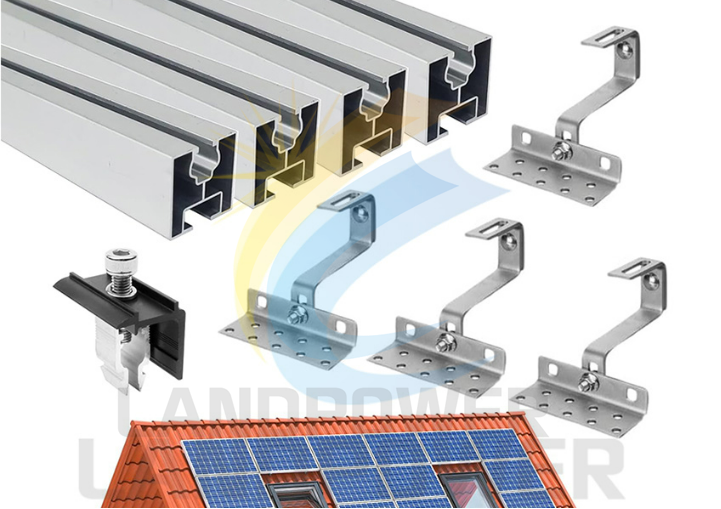
    Please see the roof hook below,they are use for installing the roof solar mounting project,The rails are also different when installing.you can kindly compare the two structures below.


    1. Fixed roof hook


    2. Adjustable roof hook


    We can supply many kinds of roof hook,and export a lot every year.if you have any inquiry,feel free contact to us.

    Emailsales9@landpowersolar.com


  • L Feet Solar Mounting

    |

    Let me introduce you to our hot product: L Feet!

    L Feet is an accessory for solar metal roof installation whose main function is to provide stable and reliable support to ensure that the solar module can effectively absorb sunlight and convert it into electricity. L Feet is uniquely designed to work with specific aluminum rail profiles and is compatible with other rail styles, increasing installation flexibility and compatibility ‌.

    We produce SUS 304 L Feet for roof solar mounting, the material is Aluminum 6005 T5 coming with1T-module,1 bolts,1 screws and EPDM pad.


    TECHNICAL INFORMATION

    Installaion site: Pitched Roof

    Size: Standard or costomized

    Material : Aluminium


    If you need this product, please feel free to contact us. Hope can work with you to cut your cost and reach mutual benefit.  (sales7@landpowersolar.com)

  • Solar Panel Bonding Jumper

    This presentation is about Solar Bonding Jumper, a member of the Landpower grounding system.

    Solar Bonding Jumper is mounted on between rails to crease electrical connection from rail to rail. It is important parts of whole solar earthing systems.

    Solar Bonding Jumper is used to mount on two pieces of anodized aluminum rails to crease aelectrical "bridge" between anodized aluminum rails which has been mechanically spliced,  the Solar Bonding Jumper is coming with stainless steel plates and washer assembled on each ends. The teeth design on stainless steel plate will make sure to the teeth penetrate into the aluminium rails to crease electrical connection. The Solar Bonding Jumper is made of tin plated, braided copper wire with make them to be best conductor.


    Technical information:

    Material: Tin Plated Copper, Stainless Steel 304

    Accommodation: Solar Mounting Rails

    Application: Between to rails to crease electrical connection


    Solar Bonding Jumper is just member of entire Landpower Solar earthing systems family. If you want to learn more earthing accessories or need any other product, feel free to contact me.(sales7@landpowersolar.com)