A 700W solar panel can generate approximately 1.96–3.08 kWh of electricity per day, assuming 3.5–5.5 peak sun hours and 80% system efficiency. Actual output depends on sunlight, temperature, shading, panel orientation, and system losses.
For homeowners, commercial solar developers, and solar equipment buyers, understanding daily energy production is essential when estimating electricity savings, planning battery storage, and selecting the right photovoltaic modules.
This guide explains how much electricity a 700W solar panel can produce daily, monthly, and annually, using practical calculations and different sunlight conditions. It also looks at how high-power N-type TOPCon modules from PNG Solar fit into modern solar projects.
How Much Electricity Does a 700W Solar Panel Generate Per Day?
A 700W solar panel has a rated output of 700 watts under Standard Test Conditions (STC). However, it does not produce 700 watts continuously throughout the day. Its actual energy production depends primarily on the available solar radiation, expressed as peak sun hours.
Using an estimated system efficiency of 80%, the expected daily electricity generation is:
Daily Energy Production (kWh) = Panel Power (W) × Peak Sun Hours × System Efficiency ÷ 1,000
For a 700W solar panel:
700W × Peak Sun Hours × 0.8 ÷ 1,000
Here, the 0.8 factor represents the assumed overall system performance after typical operating losses. It is a planning assumption rather than a guaranteed efficiency for every installation.
The following table shows the estimated daily output under three different solar conditions.
| Peak Sun Hours | Calculation | Daily Output | 30-Day Output |
|---|---|---|---|
| 3.5 hours | 0.7 × 3.5 × 0.8 | 1.96 kWh | 58.8 kWh |
| 4.5 hours | 0.7 × 4.5 × 0.8 | 2.52 kWh | 75.6 kWh |
| 5.5 hours | 0.7 × 5.5 × 0.8 | 3.08 kWh | 92.4 kWh |
These figures are planning estimates based on constant average daily peak sun hours. They are not guaranteed production levels. Seasonal weather, local irradiance, installation conditions, and equipment performance can cause actual results to vary.
How Much Electricity Can a 700W Solar Panel Produce Per Month and Year?
Daily generation provides a useful starting point, but monthly and annual production figures are often more relevant when evaluating the economic value of a solar installation.
Assuming the same average sunlight conditions throughout the year, the estimated output is:
| Peak Sun Hours | Daily Production | Monthly Production | Annual Production |
|---|---|---|---|
| 3.5 hours | 1.96 kWh | 58.8 kWh | 715.4 kWh |
| 4.5 hours | 2.52 kWh | 75.6 kWh | 919.8 kWh |
| 5.5 hours | 3.08 kWh | 92.4 kWh | 1,124.2 kWh |
The monthly figures use a 30-day month, while annual figures use 365 days. These are simplified annualized estimates, not site-specific forecasts.
For example, a 700W solar panel operating under an average of 4.5 peak sun hours could generate approximately 919.8 kWh annually under the assumed 80% system efficiency.
For larger installations, the calculation can be scaled according to the total installed panel capacity. Ten 700W panels, for example, form a 7kW DC array and could generate approximately 25.2 kWh per day under the same assumptions.
What Factors Affect the Daily Output of a 700W Solar Panel?
Panel wattage alone cannot determine actual electricity generation. Several environmental and technical factors influence how much energy a photovoltaic module produces.
- Peak sun hours: Solar irradiance is one of the most important factors. A location receiving 5.5 peak sun hours generally has greater daily generation potential than one receiving 3.5 hours.
- Panel orientation and tilt: The direction and installation angle affect how much sunlight reaches the module. The optimal configuration depends on the project's geographic location and seasonal conditions.
- Temperature: Solar modules can experience reduced power output as cell temperature rises above the STC reference temperature of 25°C. Buyers should compare the temperature coefficient in the module datasheet.
- Shading and dirt: Dust, leaves, nearby buildings, and trees can reduce solar radiation reaching the panel. Even partial shading may affect module and string performance.
- Inverter and electrical losses: DC-to-AC conversion, wiring, connections, module mismatch, and other system losses influence the electricity delivered to the load or grid.
For project developers, these factors should be evaluated together rather than relying only on the rated wattage printed on a solar panel.
Is a 700W Solar Panel More Efficient Than a 400W or 550W Panel?
A higher-wattage solar panel generally produces more electricity per module under comparable operating conditions. However, higher rated power does not automatically mean higher conversion efficiency. Panel dimensions, cell technology, and module efficiency must also be considered.
The following comparison assumes identical peak sun hours and an 80% system efficiency factor.
| Panel Rating | Output at 4.5 Sun Hours | Output at 5.5 Sun Hours | Typical Application |
|---|---|---|---|
| 400W | 1.44 kWh/day | 1.76 kWh/day | Small residential systems |
| 550W | 1.98 kWh/day | 2.42 kWh/day | Residential and commercial projects |
| 700W | 2.52 kWh/day | 3.08 kWh/day | Large commercial and utility-scale projects |
Under the same assumptions, a 700W panel produces 75% more energy per module than a 400W panel and approximately 27.3% more than a 550W panel.
However, module efficiency is calculated using rated power and panel surface area. A larger module can have a higher wattage without necessarily having a higher conversion efficiency percentage.
For buyers comparing high-power photovoltaic modules, PNG Solar's N-Type solar panel range provides a starting point for evaluating different module technologies and power ratings.
What Makes N-Type TOPCon Solar Panels Suitable for High-Power Projects?
N-type TOPCon (Tunnel Oxide Passivated Contact) is a crystalline silicon solar cell technology used in high-efficiency photovoltaic modules. It improves carrier passivation through a thin tunnel oxide layer and a doped polysilicon contact structure.
For commercial and utility-scale solar projects, N-type TOPCon modules are often evaluated for their conversion efficiency, temperature performance, degradation characteristics, and potential for bifacial power generation.
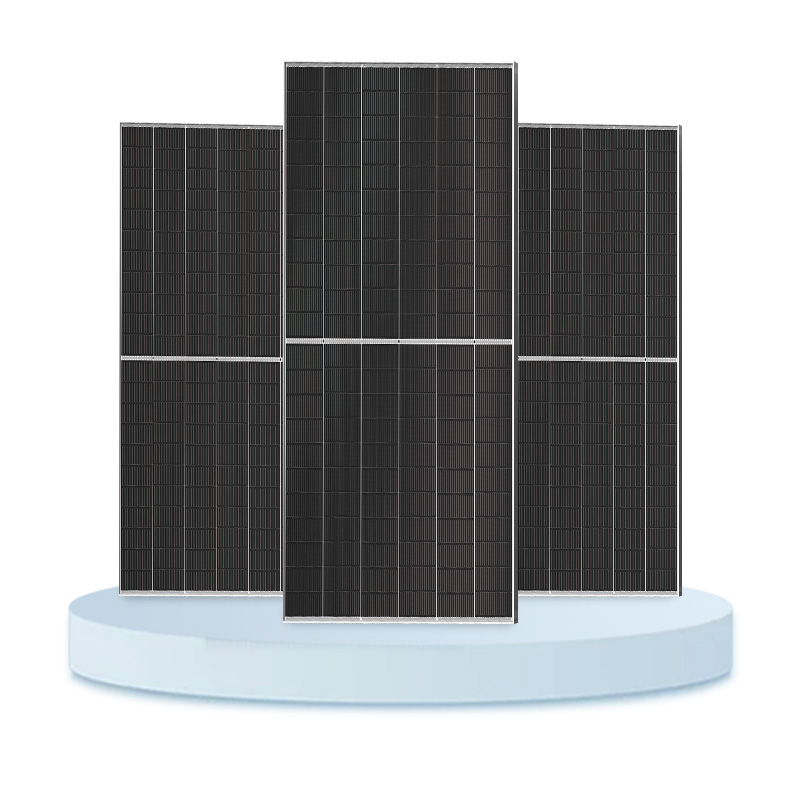
PNG Solar lists high-power N-type TOPCon photovoltaic modules in its product range, including the following specifications:
- 695W–720W series: 210mm monocrystalline N-type TOPCon modules with 132 cells.
- 715W–740W series: 210mm monocrystalline N-type TOPCon modules with 132 cells.
- 730W model: Listed module conversion efficiency of 23.70% under STC.
- 720W model: Listed module conversion efficiency of 23.20% under STC.
For example, the 695W–720W product series includes a 700W model, making it directly relevant to buyers researching 700W solar panel performance.
Buyers can review the 695W–720W N-type TOPCon solar panel specifications to compare electrical and mechanical parameters before selecting a module for a project.
The 715W–740W TOPCon solar panel series is another option for commercial buyers evaluating higher-output photovoltaic modules.
When comparing these products, check the actual datasheet for rated power, module efficiency, temperature coefficients, dimensions, weight, operating voltage, and maximum system voltage. These specifications are more useful for engineering decisions than wattage alone.
How Many 700W Solar Panels Are Needed for a Solar System?
The number of solar panels required depends on the target system capacity, available installation area, and expected electricity consumption.
A simple calculation is:
Number of Panels = Required System Capacity (W) ÷ Individual Panel Rating (W)
For 700W modules, the approximate panel quantities are:
| Target DC Capacity | Calculation | Number of Panels |
|---|---|---|
| 5kW | 5,000 ÷ 700 | 8 panels (5.6kW) |
| 10kW | 10,000 ÷ 700 | 15 panels (10.5kW) |
| 20kW | 20,000 ÷ 700 | 29 panels (20.3kW) |
| 100kW | 100,000 ÷ 700 | 143 panels (100.1kW) |
These figures represent approximate DC module capacity. Final system sizing must also account for inverter capacity, DC-to-AC ratio, string voltage, current limits, roof or ground space, and local electrical regulations.
For installations that need to operate independently of the utility grid, the design must also consider battery capacity, inverter power, and expected daily loads. PNG Solar offers off-grid solar system solutions for project configurations involving solar modules, inverters, and battery storage.
Can a 700W Solar Panel Charge a Battery?
Yes. A 700W solar panel can charge a compatible battery through an appropriately rated solar charge controller or inverter with an integrated MPPT charging function.
However, charging performance depends on solar irradiance, battery voltage, charge controller capacity, battery chemistry, charging limits, and other system conditions.
For example, under the 4.5-hour peak sunlight assumption, a 700W module generates approximately 2.52 kWh of daily energy after applying the assumed 80% system efficiency factor.
This does not mean a battery will receive the full 2.52 kWh. Additional conversion and charging losses, as well as simultaneous household or commercial loads, must be considered.
Battery sizing should therefore be based on usable energy capacity rather than nominal capacity alone. Buyers planning a complete solar storage solution can explore PNG Solar's battery and energy storage products.
FAQ About 700W Solar Panel Output
How many kWh does a 700W solar panel produce per day?
A 700W solar panel produces approximately 1.96–3.08 kWh per day when receiving 3.5–5.5 peak sun hours, assuming 80% system efficiency. At 4.5 peak sun hours, the estimated daily output is 2.52 kWh.
How many hours of sunlight does a 700W solar panel need?
A 700W solar panel does not need a fixed number of daylight hours to generate electricity. Its output depends on solar irradiance. Under 4.5 peak sun hours, it can generate approximately 2.52 kWh per day at 80% system efficiency.
How many 700W solar panels do I need to run a 5kW system?
You need approximately 8 panels rated at 700W each. Their combined DC capacity is 5.6kW, slightly above the 5kW target. The inverter and electrical system must be designed to accommodate the array.
Can a 700W solar panel run a house?
A single 700W solar panel can generate approximately 1.96–3.08 kWh per day under the stated assumptions. This can support part of a household's electricity consumption, but most homes require multiple panels. The required system size depends on daily electricity usage, location, and battery requirements.
Does a 700W solar panel produce 700W all day?
No. The 700W rating represents the module's rated DC power under Standard Test Conditions, not its continuous daily output. Actual power changes with sunlight intensity, cell temperature, shading, and other operating conditions.
Final Thoughts: Is a 700W Solar Panel a Good Choice?
A 700W solar panel can generate approximately 1.96–3.08 kWh per day under 3.5–5.5 peak sun hours and an assumed 80% system efficiency. It can be a practical option for commercial and utility-scale projects where high module power helps reduce the number of modules required for a target DC capacity.
However, selecting a solar panel should involve more than comparing wattage. Module efficiency, temperature coefficient, degradation rate, mechanical dimensions, inverter compatibility, and project-specific installation conditions all influence long-term system performance.
PNG Solar, operated by Hefei Pinergy Solar Technology Co., Ltd., was founded in 2017 and supplies PV modules, energy storage systems, and solar power solutions. Its published product range includes high-power N-type TOPCon modules from 695W to 740W.
For solar distributors, EPC contractors, and commercial project developers, comparing product datasheets and matching module specifications to actual project requirements is an important step toward building an efficient and reliable solar energy system.