In the modern era of industrial automation, 5G telecommunications, and high-capacity battery storage, electronic components are operating at higher frequencies and power levels than ever before. While most hardware developers focus heavily on thermal management and weatherproofing when designing metal housings, they often overlook a silent but equally destructive threat: Electromagnetic Interference (EMI) and Radio Frequency Interference (RFI).
If a sensitive circuit board is not properly shielded, external electromagnetic waves can cause signal degradation, data corruption, and complete system failure. Conversely, if your own high-power equipment emits too much electromagnetic noise, it will fail strict FCC or CE compliance testing, legally preventing your product from entering the market. To solve this, a sheet metal enclosure must act as a perfect Faraday cage. However, turning a fabricated metal box into an effective EMI shield requires highly specific Design for Manufacturing (DFM) strategies. Here is the ultimate engineering guide on how to design sheet metal enclosures for maximum EMI/RFI shielding.
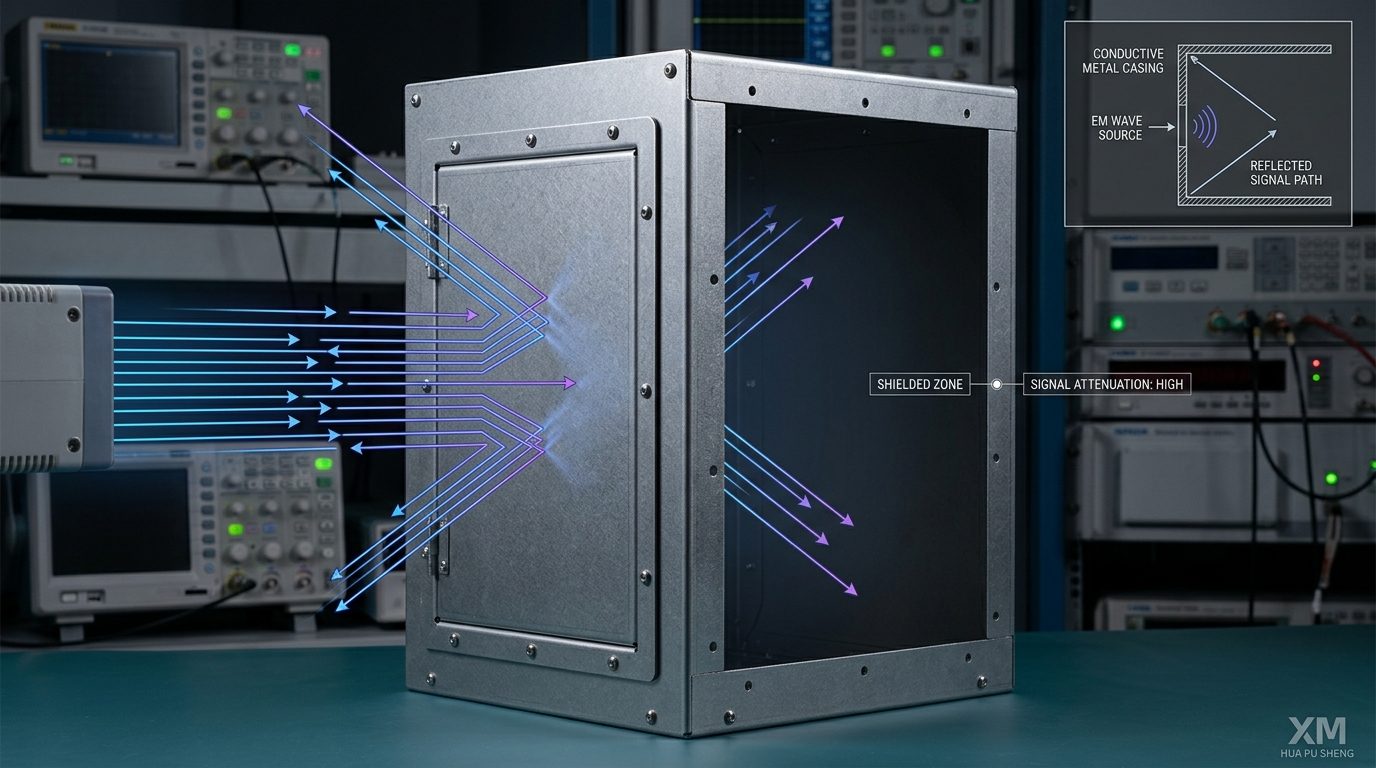
The Foundation: Material Selection and Conductivity
The fundamental principle of an EMI shield is electrical conductivity. When an electromagnetic wave hits a conductive metal surface, the wave's energy is absorbed and dispersed across the metal, preventing it from passing through. Therefore, the choice of raw material is the first critical step in enclosure design.
Aluminum is highly favored in the telecommunications and aerospace sectors because it offers excellent electrical conductivity (and thus excellent RF shielding) while remaining lightweight. For lower-frequency magnetic interference—such as the noise generated by massive transformers or industrial motors—standard carbon steel or galvanized steel actually performs better than aluminum due to its magnetic permeability. By leveraging professional Custom Sheet Metal Fabrication, engineers can select the exact alloy and thickness required to block the specific frequency ranges their equipment will encounter in the field.
The Slot Antenna Effect: Managing Seams and Doors
A solid sheet of metal is a perfect shield, but a practical enclosure requires doors, removable access panels, and cable entry points. The seams where two pieces of metal meet are the weakest points in any EMI defense strategy. In electromagnetic physics, a long, narrow gap acts as a "slot antenna." If the length of a continuous gap approaches 1/4 of the wavelength of the interference frequency, it will actively radiate electromagnetic noise, completely defeating the purpose of the metal housing.
To prevent the slot antenna effect, the gap must be mathematically broken up into smaller, electrically bonded segments. This is typically achieved by reducing the spacing between screws or rivets on mating flanges. For example, rather than placing screws 150mm apart on a server chassis, engineers may need to space them 30mm apart to ensure the maximum gap length remains shorter than the critical wavelength threshold of high-frequency 5G signals.
Conductive Gaskets: Bridging the Gap
Simply placing screws closer together is not always feasible, especially for large hinged doors that must be opened frequently by maintenance crews. When dealing with Outdoor Electrical Cabinets, manufacturers must solve two problems simultaneously: keeping rainwater out (IP65 rating) and keeping electromagnetic waves out (EMI shielding).
Standard neoprene or EPDM rubber gaskets are excellent for weatherproofing, but they are electrical insulators. If a standard rubber gasket is used, the door is electrically isolated from the main cabinet, breaking the Faraday cage. The solution is using EMI-specific gaskets. These include silicone elastomers loaded with conductive particles (like silver-plated aluminum) or woven wire mesh over a foam core. When the cabinet door is latched closed, the conductive gasket compresses, forming a continuous, watertight, and electrically conductive bridge between the door and the frame.
Ventilation Strategies: Cooling Without Leaking
High-performance electronics generate massive amounts of heat. Active cooling fans and passive ventilation louvers are mandatory. However, a large exhaust hole cut into a metal panel is a massive vulnerability for EMI leakage. How do engineers balance airflow with electromagnetic security?
The DFM rule for EMI ventilation is to use a matrix of many small holes rather than one large hole. A highly perforated sheet metal panel allows significant airflow while restricting RF waves, provided the diameter of the holes is substantially smaller than the wavelength of the interference. In advanced applications where cooling demands are extreme but radiation limits are strict, engineers utilize "honeycomb waveguides." These are specialized metal mesh filters welded over the exhaust ports that allow air to flow freely while physically trapping electromagnetic radiation inside the honeycomb cells.
The Hidden Danger of Powder Coating
One of the most frequent reasons enclosures fail EMC (Electromagnetic Compatibility) testing is a misunderstanding of surface finishes. Powder coating and liquid paint are polymers. They are excellent for preventing rust, but they are incredibly strong electrical insulators.
If an OEM designs a perfect metal box, but the fabricator powder-coats the entire chassis and the access panels before assembly, the parts will not conduct electricity when bolted together. The Faraday cage is completely broken by the layer of paint. To prevent this, sophisticated fabricators use precision high-temperature masking tape. They meticulously mask off the mating flanges, grounding stud locations, and gasket contact areas before the parts enter the powder coating oven. Once the paint is cured and the tape is removed, the contact points remain bare, highly conductive metal.
Advanced Conductive Treatments
Leaving carbon steel bare at contact points is risky because it will quickly rust. For parts requiring both high conductivity and severe corrosion resistance, bare metal is not an option. In these cases, engineers specify specialized chemical conversion coatings.
For aluminum parts, a Chromate Conversion Coating (often referred to by the brand name Alodine) is applied. This chemical bath provides excellent oxidation resistance while maintaining near-perfect electrical conductivity. For carbon steel, zinc plating with a clear passivate is utilized on the internal components. These conductive finishes ensure that high-power Energy Storage System Enclosures remain completely grounded and electrically continuous for their entire operational lifespan.
Engineering Your Next EMI-Secure Project
Designing an enclosure that passes strict CE and FCC radiation limits requires a holistic approach that bridges electrical engineering with mechanical fabrication. Every fastener location, ventilation pattern, and surface coating strategy must be meticulously planned. Failing to account for EMI during the CAD phase often results in expensive retrofitting, such as taping copper foil inside the box as a desperate, last-minute fix.
At Huapusheng, our manufacturing engineers understand the rigorous demands of electromagnetic compatibility. From laser-cutting precise micro-perforations to executing flawless powder coat masking strategies, we ensure your enclosures provide the absolute highest level of protection. Submit your 3D models to our technical team today, and let us help you optimize your hardware for flawless compliance and mass production efficiency.
Frequently Asked Questions
What is a Faraday Cage?
A Faraday cage is an enclosure formed by a continuous covering of conductive material. It operates by distributing external electrical charges and electromagnetic radiation across the exterior of the cage, canceling out the field's effect on the interior. In manufacturing, a properly grounded sheet metal box acts exactly like a Faraday cage.
Does anodizing aluminum affect EMI shielding?
Yes, drastically. While aluminum itself is highly conductive, the anodizing process creates a thick layer of aluminum oxide on the surface. Aluminum oxide is an electrical insulator. Therefore, two anodized aluminum panels bolted together will not conduct electricity across the joint, destroying the EMI shield. Chromate conversion (Alodine) should be used instead.
How big can ventilation holes be before they leak EMI?
The maximum allowable hole size depends entirely on the highest frequency generated by the internal electronics. A standard engineering rule of thumb is that the maximum dimension of any hole or slot should be less than 1/20th of the wavelength of the highest target frequency to ensure adequate attenuation (blocking).