• Design a solar system for your own house

    As the world places greater emphasis on environmental protection and sustainable energy development, solar energy, a clean and renewable energy source, is increasingly becoming a vital choice for households and businesses alike. Designing and installing an efficient and reliable solar system can not only significantly reduce energy costs but also contribute to environmental protection efforts. This comprehensive guide aims to provide you with a step-by-step guide from initial planning to ongoing maintenance, helping you embark on a green journey with solar energy.


    I. Preliminary Planning and Assessment


    Begin by assessing your energy needs, examining past electricity bills to understand your average monthly consumption and peak usage periods. Consider future energy demands based on family growth or appliance additions. Understand the geography and sunlight exposure of your location, researching average annual sunshine hours and seasonal variations.


    II. Understanding Local Policies and Incentives


    Research and leverage local government incentives for solar adoption, such as subsidies, tax credits, loan programs, or Renewable Energy Certificates (RECs). These policies can significantly reduce the cost of installing a solar system and accelerate your return on investment.


    III. Obtaining Necessary Permits and Approvals


    Ensure compliance with local regulations by obtaining necessary building permits or other approvals. Submit applications to local authorities, including proof of property ownership, design drawings, and installation plans. Prepare these materials in advance to avoid delays.


    IV. Determining Installation Location and Selecting Mounting Systems


    Choose an installation location with ample sunlight and no obstructions, preferably the rooftop but also considering ground mounts or other sturdy structures. Ensure the selected location is structurally sound to support the weight of solar panels and mounting systems. Select a reliable mounting system manufacturer like HQ Mount, with 10GW of experience, offering high-quality, customized solutions to meet various installation needs. Welcome to consult HQ Mount for professional advice if needed.


    V. Selecting and Calculating System Components


    Choose between monocrystalline, polycrystalline, or thin-film solar panels based on budget and efficiency requirements. Calculate the number of panels needed based on your energy demands, considering seasonal variations and energy storage requirements. Select an inverter compatible with your system's output and consider smart control features for remote monitoring and fault prediction.


    VI. Installation and Commissioning


    Hire a qualified and experienced installation team to handle the installation process. Ensure detailed planning and precision during installation, with proper electrical wiring and component connections. Perform system testing and commissioning to verify performance and make optimizations as needed.


    VII. Ongoing Maintenance and Management


    Regularly clean and maintain your solar panels to maintain optimal performance. Inspect electrical connections and replace worn-out components promptly. Install monitoring equipment to track system performance and use data analysis to identify and address potential issues.


    VIII. Enjoying the Benefits of Solar Energy


    Experience the joy of reduced electricity bills, energy independence, and a positive impact on the environment. Solar energy adoption contributes to carbon emission reductions and promotes a greener lifestyle.


    By following this comprehensive guide, you will smoothly navigate the process of designing, installing, and maintaining an efficient and reliable solar system. This endeavor will not only yield significant economic benefits for your household or business but also contribute to the global effort towards a greener and more sustainable future. Let us embark on this journey together!


    HQ Mount located in Xiamen, China, is specialized in researching and developing, manufacturing, selling solar mounting system solutions. Our products mainly include solar balcony mount, roof mount, grounding mount, solar carport, solar farm and all mounting accessories.

    CONTACT US---XIAMEN HQ MOUNT TECH CO.,LTD

    Whatsapp : 18030160771

    Tel : 86 05926252889

    Email : allie@hqmount.com

  • Why Are Solar Mounting Systems Essential for Efficient Solar Energy Production?

    solar structure manufacturers

    Solar energy has emerged as a frontrunner in the quest for clean, renewable energy sources. Central to the success of any solar installation is the mounting system that supports the solar panels. In this blog post, we will discuss why solar mounting systems are essential for efficient solar energy production, with a focus on the innovative solutions provided by SIC Solar, a leading manufacturer of photovoltaic mounting systems.


    1. Optimal Angle and Orientation

    - Solar mounting systems allow for the precise positioning of solar panels at the optimal angle and orientation to maximize sunlight exposure. SIC Solar's adjustable mounting systems ensure that panels can be tilted to capture the sun's rays throughout the day and across the seasons.

    2. Structural Integrity and Safety

    - A robust solar mounting system is crucial for the safety and longevity of a solar installation. SIC Solar's systems are engineered to withstand various weather conditions and loads, providing a secure foundation for solar panels.

    3. Versatility in Installation Options

    - Mounting systems offer flexibility in installation, whether on rooftops, ground, or other structures. SIC Solar's diverse range of products caters to different installation environments, ensuring a tailored solution for every project.

    4. Minimized Environmental Impact

    - Ground-mounted solar systems using SIC Solar's mounting solutions can be installed with minimal disruption to the natural environment, often without the need for excavation or concrete foundations.

    5. Ease of Maintenance

    - Proper mounting systems facilitate easier access to solar panels for cleaning and maintenance, contributing to the overall efficiency and lifespan of the solar array. SIC Solar's designs prioritize ease of maintenance without compromising on stability.

    6. Scalability and Expandability

    - As energy needs grow, the ability to expand the solar installation is important. SIC Solar's mounting systems are designed to be scalable, allowing for the addition of more panels as required.

    7. Compliance with Standards and Regulations

    - Solar mounting systems must meet specific industry standards and regulations for safety and performance. SIC Solar ensures that their products are compliant with these standards, providing peace of mind for installers and users.

    8. Enhanced Aesthetics

    - The visual appeal of a solar installation can be a consideration, especially for residential applications. SIC Solar's mounting systems are designed to be discreet and visually pleasing, blending seamlessly with the architecture.

    9. Energy Yield Maximization

    - The efficiency of solar panels is directly related to the amount of sunlight they receive. SIC Solar's mounting systems are designed to maximize energy yield by ensuring panels are positioned to receive the maximum amount of sunlight.

    10. Quick and Efficient Installation

    - Time is a significant factor in solar installation projects. SIC Solar's mounting systems are designed for quick and efficient installation, reducing labor costs and getting the system operational faster.

    11. Cost-Effectiveness

    - While the initial investment in a solar mounting system is important, the long-term savings in energy costs justify the expense. SIC Solar's systems offer a cost-effective solution that pays for itself over time through energy savings.

    12. Durability and Longevity

    - The longevity of a solar installation is heavily dependent on the quality of the mounting system. SIC Solar's durable materials and construction ensure that their mounting systems last for decades, protecting the solar panels from wear and tear.


    Solar mounting systems are the backbone of any solar energy project, ensuring the efficiency, safety, and longevity of solar installations. SIC Solar, with its commitment to innovation and quality, provides the essential components for harnessing the sun's energy effectively. By choosing SIC Solar's mounting systems, homeowners and businesses can maximize the potential of their solar panels, contributing to a sustainable and energy-efficient future.

  • The choice between integrated solar street lights or split solar street lights-Which is the best?

    The choice between integrated solar street lights or split solar street lights depends on the specific usage environment and requirements. Here are their respective characteristics and advantages and disadvantages for reference:


    integrated solar street lights or split solar street lights


    Integrated solar street lights

    Advantage:

    Compact design, easy installation and maintenance, no need to lay too many wires and cables.

    Can save space without occupying ground space.

    Integrated with solar panels, energy storage batteries, and control systems, it has independent power supply capability.

    Using solar energy as the main power supply is environmentally friendly and energy-saving.

    Disadvantages:

    The charging efficiency and light compensation capability are affected by weather conditions, which may lead to insufficient charging and lighting time in areas with continuous rainy weather or insufficient winter sunshine.

    High cost and initial investment.


    Split solar street light

    Advantage:


    The solar panels and LED lights are installed separately, and the solar panels can be adjusted according to the optimal angle of lighting conditions to achieve higher charging efficiency.

    The independent design of solar panels and lamp heads can improve system flexibility and practicality.

    The wire connection between the solar panel and the lamp head is relatively short, reducing line loss and safety hazards.

    Disadvantages:
    Installation and maintenance are relatively complex, requiring the arrangement of more wires and cables.

    Occupying a significant amount of ground space.

    Split design may result in higher overall system costs.


    The best choice depends on specific needs and usage environment. If the environmental lighting conditions are good, a street light system that requires simple installation and maintenance, and can tolerate high initial investment costs, integrated solar street lights may be a good choice.

    If it is necessary to adjust the optimal installation angle according to the lighting conditions, have high flexibility requirements for the street lamp system, and can arrange more installation space and manpower resources, split solar street lamps may be more suitable.


    The best choice depends on specific needs and usage environment

    sales@szleadray.com

    +86-13424390319

  • Will Solar Panels Work In a Power Cut?

    Solar panels alone cannot provide power during a power cut unless they are part of a system that includes a battery storage solution or a special inverter capable of operating independently of the grid. Here’s a detailed look at the different configurations and how they perform during a power outage:


    On-Grid Solar Systems

    How They Work:

    Connection: These systems are directly connected to the local utility grid.

    Operation: During normal operation, the solar panels generate electricity, which is used to power your home. Excess electricity is sent back to the grid, often earning you credits or compensation.

    Power Cut Scenario: In the event of a power cut, on-grid systems automatically shut down for safety reasons (to protect utility workers from potential electric shocks).

    Solution:

    On-Grid systems require additional components to work during power cuts:

    Battery Storage: Adding a battery to your system allows you to store excess solar energy, which can be used during a power outage.

    Hybrid Inverter: These inverters can switch to battery power and operate independently of the grid during outages.

    Off-Grid Solar Systems

    How They Work:

    Connection: These systems are not connected to the utility grid and are designed to be self-sufficient.

    Components: They rely on batteries to store energy generated by the solar panels, ensuring power availability when there is no sunlight.

    Power Cut Scenario: Off-grid systems continue to provide power during a grid outage since they are not dependent on the grid.

    Solution:

    Off-grid systems are inherently capable of providing power during outages due to their reliance on stored energy in batteries.

    Hybrid Solar Systems

    How They Work:

    Connection: These systems combine the benefits of both grid-tied and off-grid systems.

    Operation: They can be connected to the grid and have battery storage for backup power.

    Power Cut Scenario: During a power outage, a hybrid system can switch to battery power, ensuring a continuous supply of electricity.

    Solution:

    Hybrid systems are ideal for ensuring power during outages while still being able to benefit from grid connectivity and net metering.

    Key Components for Backup Power

    1. Batteries

    Function: Store excess energy generated by solar panels.

    Types: Lead-acid, lithium-ion, and other advanced battery technologies.

    Consideration: Size and capacity of the battery should match your energy consumption needs.

    2. Inverters

    Function: Convert DC electricity generated by solar panels to AC electricity used by home appliances.

    Types:

    Standard Inverter: Works only when connected to the grid.

    Hybrid Inverter: Can switch to battery power and operate independently during a power outage.

    3. Charge Controllers

    Function: Regulate the amount of charge going into the batteries to prevent overcharging.


    Solar panels alone will not provide power during a power cut if you have a standard grid-tied system. To ensure your solar panels work during outages, you need either an off-grid system, a grid-tied system with battery storage, or a hybrid system. For a reliable backup solution, investing in a battery storage system and a hybrid inverter is essential. This setup not only provides power during outages but also maximizes the use of renewable energy generated by your solar panels.

  • 5 THINGS TO CONSIDER BEFORE INSTALLING ROOFTOP SOLAR PANELS

    1. What is the shape of your roof?

    Roofs come in many different shapes and sizes. Before you go ahead with any installation, make sure that your roof has enough space for the rooftop solar panels. If there isn’t enough room, you likely will not get the return you expect on your investment.


    2. Where will the water go?

    When it rains, water runs down the roof, into the gutters and out and away from your home. When installing solar panels, equipment like solar panel roof brackets and wire harnesses can prevent the water from flowing and draining properly. In some cases, solar equipment can move the water in a different direction, which can create leaks and other problems. These problems will need repair, which means the solar panels will need to be removed.


    3. Did you pick the cheapest options?

    Cheaper solar panels rarely translate to better solar panels. While the technology has dropped significantly in price over the past decade, investing in the cheapest models or brands of solar panels can leave you in the dark. Cheaper or low end solar panels are often manufactured in a way that makes them less durable. When solar panels are less durable, it decreases your investment value as well as potential future savings. The scary part is that these lower quality panels can sometimes be dangerous, resulting in safety hazards. The last thing you want is to have a fire start in your home because of low quality solar panels.


    4. What about warranties?

    Warranties are an important aspect of protecting your solar panels and other related equipment. If anything happens to your solar panels, having a warranty helps you to keep the manufacturer accountable — without any additional cost to you. There are also some incentive programs (available in many different states) that require you to have a warranty for your solar equipment.


    5. Don’t forget about maintenance.

    Keeping your solar panels working and your roof in good condition is all about establishing proper maintenance procedures. It’s a good idea to find out from rooftop solar panel manufacturer what those maintenance procedures are before the installation begins. If you are unable to meet those maintenance requirements, there is a good chance your equipment will not last as long as you want it to.

  • Shingled Solar Panels VS. Solar Tiles VS. Standard Solar Panels

    When it comes to powering your home with solar energy, standard photovoltaic (PV) solar modules are a common choice. However, the cutting-edge technology of shingled solar PV panels offers an innovative alternative. It's important to note that shingled solar panels are distinct from solar tiles, despite their similar names and purposes. This article will explore the differences between shingled solar panels and solar tiles, compare shingled solar panels with conventional modules, and highlight the advantages of this technology to help you determine if it's the right option for you.

     Shingled Solar Panels Solar Tiles Standard Solar Panels


    Shingled Solar Panels vs. Solar Tiles(Solar Shingles)


    Shingled Solar Panels:

    Shingled solar panels utilize laser slicing technology to cut solar cells into multiple strips and interconnect them with electrically conductive adhesive. This optimization of component structure achieves zero spacing between cells, allowing for a 5% increase in cell placement compared to other types of modules, effectively enhancing the solar panel's conversion efficiency.


    Solar Tiles:

    Solar tiles serve as both a source of electricity and structural support for your roof, integrating seamlessly into building aesthetics. However, while aesthetically pleasing, their conversion efficiency typically ranges from 15% to 20%, lower than shingled solar panels which can reach up to 23.5%. Moreover, solar tiles are priced higher, ranging from $0.8 to $2 per watt, compared to shingled solar panels which range from $0.18 to $0.25 per watt.


    Shingled Solar Panels vs. Standard Solar Panels


    Interconnection of Cells:

    Conventional modules rely on copper busbars or ribbons to connect cells, resulting in gaps between them. In contrast, shingled modules eliminate these gaps by assembling cells into strips with electrically conductive adhesive. This method enhances efficiency and durability, with shingled panels boasting efficiency rates between 22% to 23.5%.


    Panel Efficiency:

    Standard solar panels typically achieve efficiencies ranging from 15% to 22.6%, while shingled panels surpass this range, reaching efficiencies between 22% to 23.5%. This higher efficiency is complemented by shingling technology's compatibility with glass-glass and bifacial techniques, further improving light absorption and minimizing losses.


    Mechanical Performance:

    Shingled solar panels demonstrate superior mechanical strength against external forces like wind and snow compared to conventional panels. They maintain structural integrity without micro-cracks or power attenuation even after rigorous load testing, ensuring long-term reliability.


    Aesthetics:

    Shingled solar cells offer a sleek, all-black appearance by eliminating visible ribbons and busbars, enhancing the overall design of buildings.


    Advantages of Shingled Solar Panels


    Higher Power Density:

    Shingled solar panels maximize power production per square meter, utilizing the entire effective area without gaps, leading to increased energy output in less space.


    Lower Energy Loss:

    Parallel wiring of shingled solar cells minimizes the impact of shading and reduces energy losses compared to series-wired conventional cells. Additionally, lower ohmic losses contribute to improved performance.


    More Aesthetic:

    The sleek design of shingled panels enhances the visual appeal of homes, offering a modern and stylish alternative to conventional modules.


    More Reliable:

    Shingled panels exhibit robust performance, resisting shading, mechanical stress, and low current operation, ensuring consistent and dependable energy production.


    Are Shingled Solar Panels Right for You?


    Shingled solar panels are an innovative choice, particularly suitable for residential applications. As manufacturers adopt this technology, prices are expected to decrease, making them increasingly accessible. If you prioritize cutting-edge technology, enhanced power production, efficiency, reliability, and aesthetics, shingled solar panels are worth considering.


    Less Expensive:

    Compared to solar tiles, shingled solar panels offer a more cost-effective solution, both in terms of manufacturing and installation.


    Easier Maintenance:

    Shingled panels require minimal maintenance, primarily periodic cleaning, offering convenience and ease of ownership compared to solar tiles.


    Conclusion


    Shingled solar panels represent a promising advancement in solar technology, offering higher efficiency, improved aesthetics, and greater reliability. As the market expands and prices decrease, they become an attractive option for homeowners seeking efficient and stylish solar solutions.

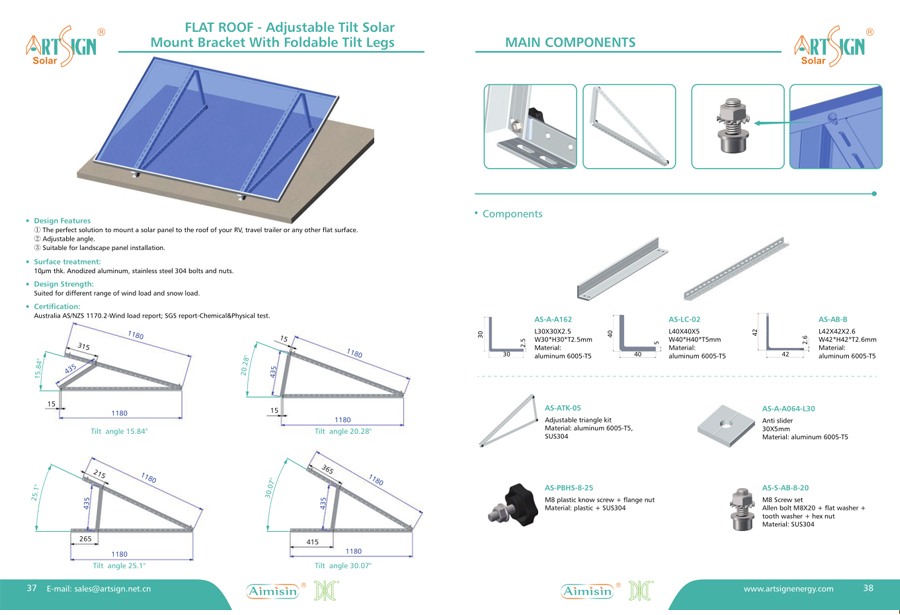
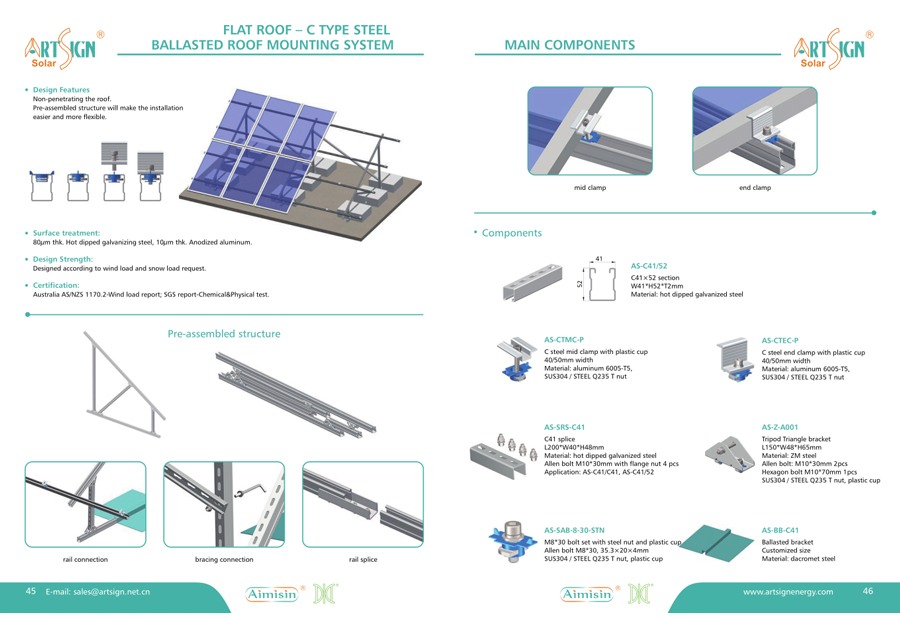
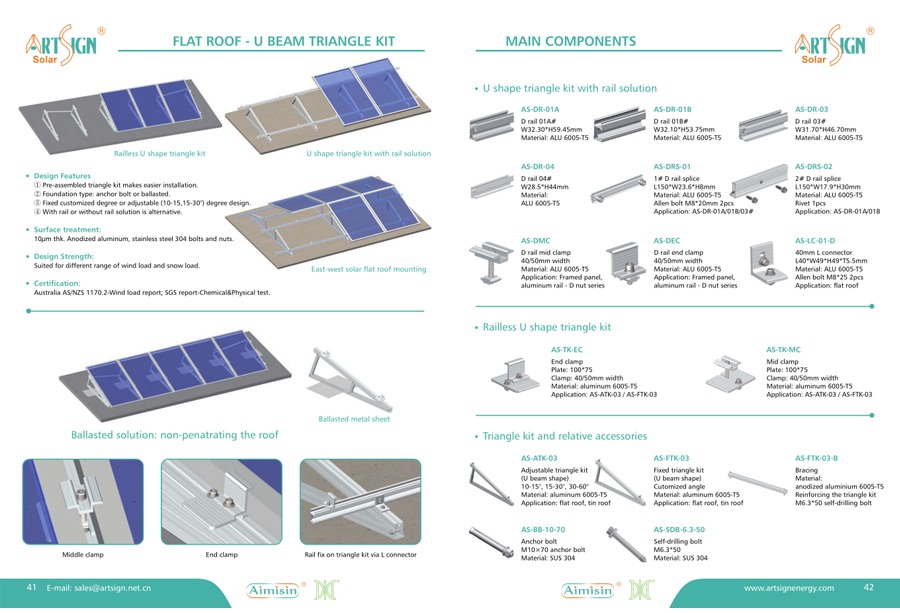
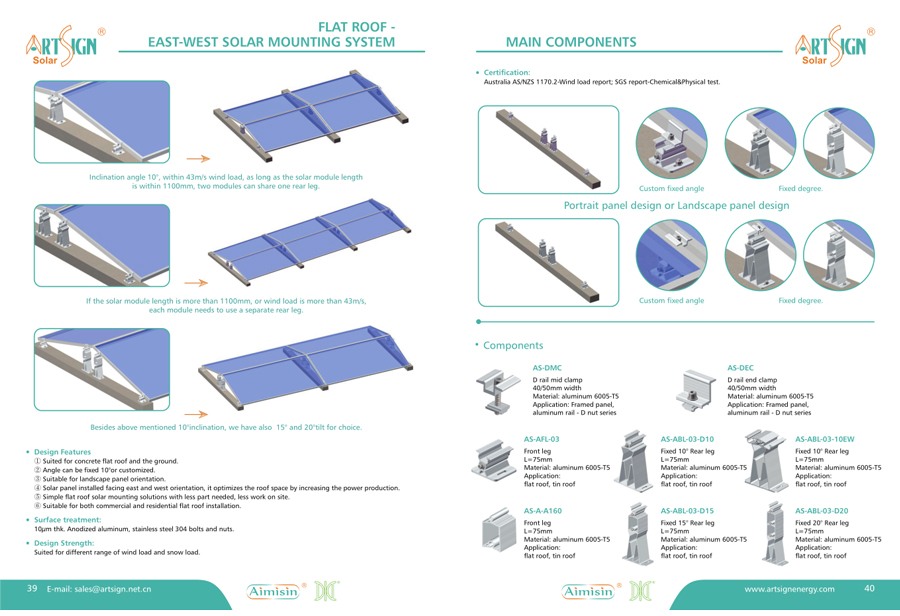
  • Flat Rooftop Solar Mounting Racking System Solution

    Xiamen Art Sign Co., Ltdis a solar mount system factory in China start from 2006. There are many kinds of  Aluminum products and galvanized steel products.
    Please allow me to introduce products we have:
    Products:
    1: Roof Mount: Pitched Roof Mount & Flat Roof Mount
    2: Ground Mount: Aluminum Ground Mount, Steel Ground Mount and Carport Solar Mounting system
    3: Customized Structure: Container Energy House Mounting Structure, Solar Agricultural Mount, CCTV POLE Mounting Structure etc.
    4: PV Accessories: Aluminum Profile, steel C Profile, Stainless Steel Roof Hook and other accessories
    For Rooftop Solar Mounting Racking System Solution
    Flat Roof PV Racking Solution
    Suitable for many kinds of buildings, such as: houses, schools, shopping malls, hospitals, etc., where the roof is a flat platform or terrace.
    There are some features of Flat roof racking system:
    1、good compatibility. Suitable for different solar models of components;
    2、strong stability, improve snow resistance, wind resistance.
    3、unique design, easy to install, low maintenance cost;
    4、high corrosion resistance, greatly improve service life;
    5、a variety of solar roof hook design, optional installation programme.

    Following are Xiamen flat roof solar triangle mounting solution:

     Flat roof racking system


    Xiamen Art Sign ballast roof solar mounting solution:

    Flat Roof PV Racking

    Xiamen Art Sign U BEAM roof solar mounting solution:

    solar mount system

    Xiamen Art Sign EAST-WEST roof solar mounting solution:

    Flat Rooftop Solar Mounting Racking System


    As a leading manufacturer of solar mounting systems. We design and manufacture a wide range of PV mounts for roofs, such as tile roof solar mounting brackets, tin roof mounting brackets, and many single PV mounting accessories, such as our ever popular ceramic roof solar hooks, short rails for tin roof, solar mounting L-feet and double thread solar hanger bolt, etc.
    For any inquiries for solar panels mounting sturcture.please feel free to contact us, E-mail: sales@artsign.net.cn, whatsapp/wechat/skype:+86 18030235875, thanks.


  • Maximizing Solar Efficiency Dual Tilt Solar Racking Systems

    In the renewable energy landscape, optimizing solar panel orientation is crucial for maximizing energy output. Dual tilt solar racking systems provide an innovative solution, enabling solar panels to capture sunlight more efficiently by utilizing a bi-facial orientation. 

    Understanding Dual Tilt Solar Racking Systems

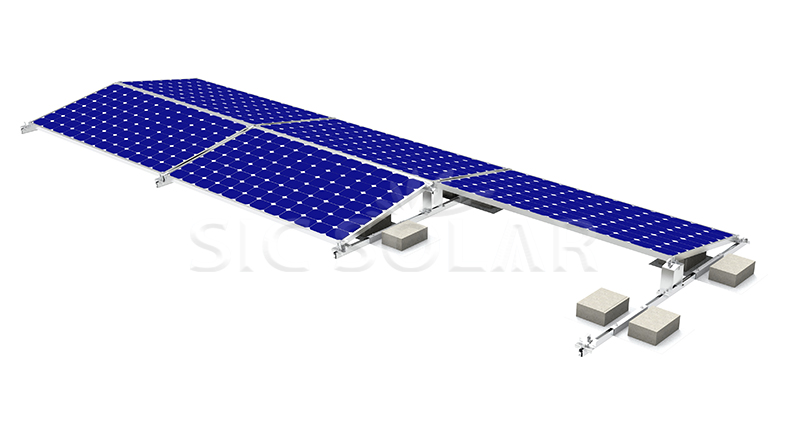
    Dual tilt solar racking systems, also known as east-west racking systems, are designed to orient solar panels in two directions. This configuration allows panels to capture sunlight during both the morning and afternoon, thereby increasing overall energy production. The dual tilt design optimizes the use of available space, particularly on flat rooftops, by reducing shading and allowing for a higher density of panels.

    Key Features and Benefits

    1. Enhanced Energy Production: By tilting solar panels in both east and west directions, dual tilt systems capture more sunlight throughout the day compared to traditional south-facing systems. This leads to a more consistent and higher total energy output.

    2. Space Efficiency: Dual tilt racking systems enable a higher density of solar panels on a given surface area. This is particularly beneficial for flat roofs or ground-mounted arrays, where maximizing the number of panels can significantly boost energy production.

    3. Reduced Shading: The unique orientation of dual tilt systems minimizes shading between rows of panels, allowing for optimal performance even in tightly spaced installations. This design helps to maintain consistent energy production throughout the day.

    4. Lower Wind Load: Compared to single tilt systems, dual tilt configurations have a lower profile and are less susceptible to wind loads. This increases the stability and durability of the installation, particularly in areas prone to high winds.

    5. Ease of Installation: Dual tilt racking systems are designed for simplicity and speed of installation. Pre-assembled components and modular designs reduce installation time and labor costs, making the process more efficient and cost-effective.

    6. Cost-Effective: With increased energy production and efficient use of space, dual tilt systems offer a higher return on investment. The reduced need for additional structural support due to lower wind loads also contributes to overall cost savings.

    Applications

    Dual tilt solar racking systems are suitable for a wide range of applications, including:

    - Residential Flat Roofs: Maximizing solar energy production on residential flat roofs.

    - Commercial and Industrial Buildings: Large-scale installations on flat rooftops of commercial and industrial buildings.

    - Solar Farms: Ground-mounted solar farms where space efficiency and maximum energy output are critical.

    - Community Solar Projects: Shared solar installations that benefit multiple users from a single system.

    Partnering with SIC Solar

    To ensure the successful implementation of dual tilt solar racking systems, partnering with a reputable supplier is essential. SIC Solar, a leading provider of solar mounting solutions, offers a comprehensive range of dual tilt racking systems tailored to meet the diverse needs of solar projects. With SIC Solar's expertise and support, solar installers and project developers can achieve seamless integration and optimal performance of their solar systems.

    Conclusion

    Dual tilt solar racking systems represent a significant advancement in solar technology, providing enhanced energy production, space efficiency, reduced shading, lower wind load, ease of installation, and cost-effectiveness. These benefits make dual tilt systems an ideal choice for various solar applications, from residential rooftops to large-scale solar farms. Partnering with SIC Solar ensures reliable and efficient solutions for maximizing solar energy potential, paving the way for a sustainable and energy-efficient future.

    Dual tilt solar racking

  • Enhancing Solar Installations Non-Penetrating Solar Roof Mounts

    As the adoption of solar energy continues to rise, the need for efficient and reliable mounting solutions becomes increasingly important. Non-penetrating solar roof mounts have emerged as a preferred option for installing solar panels on various types of roofs without compromising the roof’s integrity. 

    Understanding Non-Penetrating Solar Roof Mounts

    Non-penetrating solar roof mounts are designed to secure solar panels on rooftops without the need for drilling or penetrating the roof surface. Instead of relying on screws or bolts that pierce the roof membrane, these mounts use weights (ballast) or adhesive materials to hold the panels in place. This method protects the roof from potential leaks and structural damage, making it an ideal solution for both residential and commercial buildings.

    Key Features and Benefits

    1. Protection of Roof Integrity: Non-penetrating mounts prevent any damage to the roof membrane, reducing the risk of leaks and extending the roof’s lifespan. This feature is especially beneficial for flat roofs and roofs with delicate or older materials.

    2. Ease of Installation: These mounts are designed for quick and straightforward installation, reducing labor costs and installation time. The pre-assembled components and modular design make the process efficient, enabling faster project completion.

    3. Versatility and Flexibility: Non-penetrating mounts are versatile and can be used on a variety of roof types, including flat, low-slope, and some pitched roofs. They are compatible with different solar panel sizes and configurations, offering flexibility to meet specific project requirements.

    4. Optimal Tilt and Orientation: These mounting systems allow for the optimal tilt and orientation of solar panels to maximize sunlight exposure and energy production. Adjustable tilt options can be customized based on geographic location and seasonal variations.

    5. Durability and Stability: Constructed from high-quality materials such as aluminum and stainless steel, non-penetrating mounts are designed to withstand harsh weather conditions, including wind, rain, and snow. The ballast or adhesive methods ensure that the system remains stable and secure over time.

    6. Cost-Effective: By avoiding roof penetrations, these mounts reduce the need for additional waterproofing measures and roof repairs, leading to lower overall project costs. The ease of installation also contributes to cost savings.

    Applications

    Non-penetrating solar roof mounts are suitable for a wide range of applications, including:

    - Residential buildings with flat or low-slope roofs

    - Commercial and industrial buildings

    - Educational institutions

    - Government and municipal buildings

    - Warehouses and distribution centers

    Partnering with SIC Solar

    To ensure the successful implementation of non-penetrating solar roof mounts, partnering with a reputable supplier is essential. SIC Solar, a leading provider of solar mounting solutions, offers a comprehensive range of non-penetrating mounts designed to meet the diverse needs of solar projects. With SIC Solar's expertise and support, solar installers and project developers can achieve seamless integration and optimal performance of their solar systems.

    Conclusion

    Non-penetrating solar roof mounts provide an efficient, durable, and versatile solution for securing solar panels on rooftops without compromising the roof’s integrity. With benefits such as ease of installation, versatility, optimal tilt, durability, and cost-effectiveness, these mounts are essential for the success of solar projects on various roof types. Partnering with SIC Solar further enhances the reliability and efficiency of these installations, ensuring a sustainable and effective transition to renewable energy.

    non penetrating solar roof mount

  • Industry Dynamics of Solar Mounting Systems in Turkey

    Turkey is experiencing significant growth in the solar energy sector, with a particular focus on solar photovoltaic (PV) installations. The development of robust solar mounting systems is crucial for optimizing energy production and ensuring the long-term reliability of solar PV installations. This article provides a concise overview of the industry dynamics and trends surrounding solar mounting systems in Turkey.


    The increasing adoption of solar energy in Turkey has stimulated the demand for high-quality solar mounting systems. These systems serve as the foundation for solar PV panels and play a crucial role in maximizing energy generation by providing sturdy support and optimal panel alignment.


    The Turkish solar mounting system industry is witnessing ongoing technological advancements. Manufacturers are developing innovative designs that offer improved ease of installation, increased adjustability, and enhanced durability. Advanced features, such as tilt angle adjustability and tracking capabilities, enable solar panels to capture sunlight more effectively, leading to higher energy yields.


    To ensure the safety and reliability of solar installations in Turkey, regulatory bodies have implemented certification standards for solar mounting systems. Compliance with these standards is essential for manufacturers and installers, ensuring that systems meet quality and performance requirements. Adherence to these standards provides confidence to investors and promotes a sustainable solar energy sector.


    The growing demand for solar mounting systems has spurred competition among domestic and international manufacturers. The Turkish market has witnessed the emergence of local manufacturers, contributing to job creation and the development of a domestic supply chain. Local production not only supports the economy but also offers the advantage of shorter lead times and easier access to technical support and after-sales services.


    The integration of solar mounting systems into building and infrastructure projects is gaining traction in Turkey. Developers and architects are incorporating solar PV systems into commercial buildings, housing complexes, and industrial facilities. This integration requires specialized solar mounting systems that can seamlessly blend with the existing structures while ensuring optimal energy production.


    Turkey's solar mounting system industry is experiencing dynamic growth driven by the increasing adoption of solar energy. Technological advancements, adherence to regulatory standards, market competition, local manufacturing, and integration with building projects are shaping the industry. These developments are key to unlocking the full potential of solar energy and supporting Turkey's transition towards a sustainable and renewable future.