
You must match your energy storage enclosure protection level and material to the operating environment and regulatory standards. Verify that the manufacturer delivers documented quality and complies with export requirements. A wrong choice causes corrosion, safety failures, certification rejections, or costly rework. Start by defining your installation environment. Then work through material, certifications, dimensions, supplier quality, and cost. XIAMEN HUAPUSHENG SHEET METAL MANUFACTURING CO., LTD. provides expert guidance and high-quality enclosures to support your project.
Key Takeaways
-
Match the enclosure's IP or NEMA rating to your site's environment. Indoor sites need lower ratings. Outdoor sites need higher ratings.
-
Choose the right material for your enclosure. Aluminum is lightweight and resists corrosion. Stainless steel works well in harsh conditions.
-
Check the manufacturer's quality documents and certifications. This ensures safety and compliance. It also prevents costly problems later.
Match Your Energy Storage Enclosure to the Installation Environment
Your installation site dictates every downstream decision. A unit that performs well in a climate-controlled factory may fail within months on a coastal solar farm. You must define the placement, exposure level, and local fire codes before you compare materials or request quotes. This step prevents over-specification, which wastes budget, and under-specification, which risks safety and certification.
Indoor vs. Outdoor Placement
Indoor and outdoor installations demand different protection strategies. Indoor commercial and industrial battery energy storage system (BESS) enclosures typically carry IP54 to IP65 ratings. These ratings suit factories, warehouses, and commercial spaces. They provide moderate dust and moisture protection while keeping cost efficiency. Outdoor enclosures usually require IP65 to IP67 ratings. Solar farms, EV fast-charging stations, and microgrids expose systems to rain, dust storms, and high humidity. The key difference is straightforward: indoor applications can use lower IP ratings to minimize cost, while outdoor installations require higher ratings for environmental protection.
Outdoor placement introduces failure modes that indoor sites rarely see. Excess heat ranks as a prime cause of malfunction and failure in electrical components. Even when devices do not fail immediately, high temperatures shorten service life. Extremely cold temperatures harm performance. Condensation inside an outdoor enclosure may require heating to keep internal temperatures within acceptable limits. Wind itself is not the main problem for a well-designed enclosure. Dirt, dust, and debris enter through inadequate or broken seals, clog air filters, and reduce cooling efficiency and heat transfer.
You should evaluate four environmental factors for any outdoor site:
-
Temperature extremes and solar exposure
-
Humidity and condensation risks
-
Dust, sand, or airborne contaminants
-
Coastal or industrial environments causing corrosion
Each factor maps to a specific failure mechanism. Moisture causes short circuits, corrosion of internal components, and insulation breakdown. Condensation, rain, snow, and washdown water are common sources. Fine dust accumulates on circuit boards, causing overheating and electrical shorts. Larger debris damages moving parts or blocks ventilation. Thermal cycling causes expansion and contraction that can crack solder joints and damage electronics. Chemical vapors, salt spray, and acidic or alkaline substances rapidly degrade enclosure materials and internal components. Sunlight breaks down plastic enclosures over time. You should confirm that your chosen energy storage enclosure addresses every factor present at your site.
IP and NEMA Rating Requirements
The IP rating defines how well your enclosure blocks dust and water. The first digit covers solids, and the second digit covers liquids. Higher numbers mean stricter protection. The table below shows the ratings you will encounter most often in energy storage projects.
|
IP Rating |
Dust Protection |
Water Protection |
Typical ESS Use |
|---|---|---|---|
|
IP54 |
Limited ingress (5) |
Splash from any direction (4) |
Indoor cabinets, sheltered sites |
|
IP55 |
Limited ingress (5) |
Low-pressure jets (5) |
Semi-outdoor commercial cabinets |
|
IP65 |
Dust-tight (6) |
Low-pressure jets (5) |
Outdoor residential wall-mount |
|
IP66 |
Dust-tight (6) |
High-pressure jets (6) |
Coastal, cyclone-prone, fully exposed |
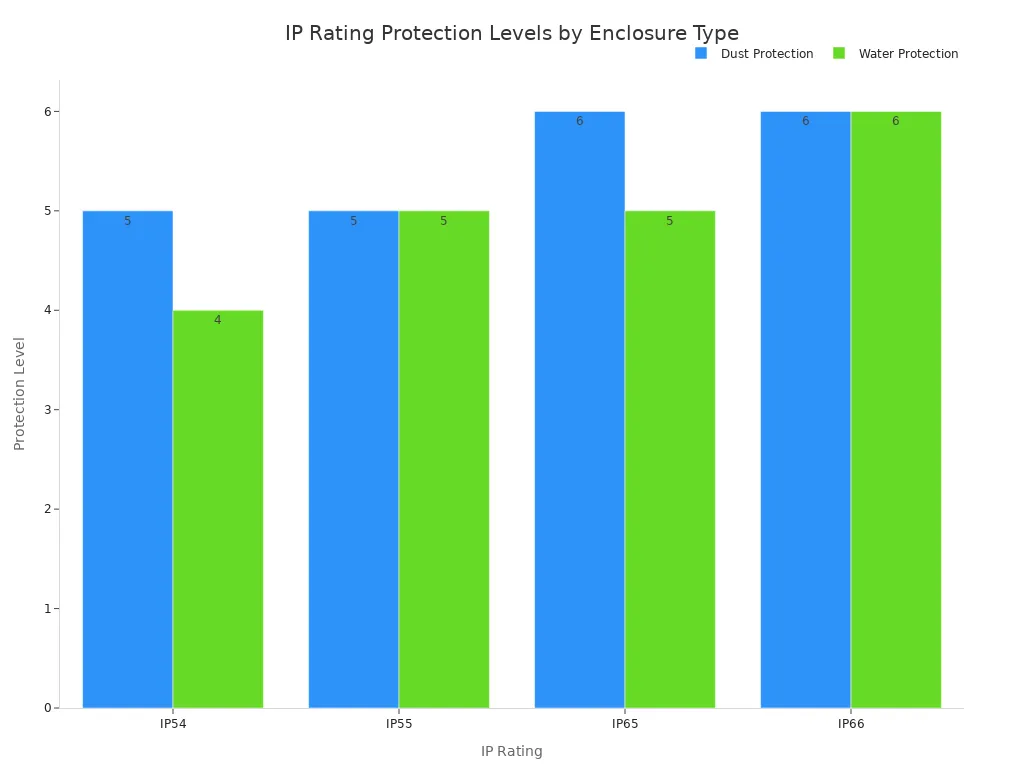
Indoor-only enclosures at IP54 protect against splashes and light dust. Outdoor enclosures at IP65 or IP66 are dust-tight and withstand directed water jets. You should match the rating to the actual exposure, not to a generic assumption. The following table gives practical guidance by site type.
|
Installation Environment |
Recommended IP Rating |
|---|---|
|
Indoor utility room / basement |
IP20–IP54 |
|
Garage / carport |
IP55 |
|
Covered outdoor wall (eaves) |
IP55–IP65 |
|
Fully exposed outdoor site |
IP65–IP66 |
|
Coastal / high humidity |
IP66 |
|
Flood-risk area |
IP67 |
NEMA ratings often appear alongside IP ratings in North American projects. The two systems overlap but do not match one-to-one. You can use this sequence to align them:
-
Indoor, clean environment → NEMA 1 / IP20
-
Indoor, dust and drip → NEMA 12 / IP52
-
Outdoor, rain and dust → NEMA 3 / IP54
-
Outdoor, hose-down washable → NEMA 4 / IP66
-
Outdoor, corrosive environment → NEMA 4X / IP66
-
Submersible → NEMA 6 or 6P / IP67
The pattern is clear. Indoor settings need only IP20 to IP52. Outdoor settings start at IP54 and climb to IP67 as exposure severity increases. A coastal site with salt spray needs NEMA 4X construction, which adds corrosion-resistant material or coating. A flood-risk area pushes you toward IP67. You should document the target rating in your purchase specification and require the manufacturer to test against it.
Fire Safety Considerations
Fire safety separates a compliant energy storage enclosure from a liability. UL 9540A complements UL 9540 by providing the test method for evaluating thermal runaway and fire propagation. Thermal runaway occurs when a battery cell increases in temperature faster than it can dissipate heat. This self-heating can lead to off-gassing, fire, or explosion. UL 9540A provides a test method for evaluating what happens when an ESS goes into thermal runaway. The standard does not define a pass/fail criterion. You must evaluate the test results to determine whether the system performed as designed. Testing occurs at four levels: cell, module, unit, and installation. Battery cells are intentionally heated to force thermal runaway, and observers record the resulting event, including whether fire propagates to neighboring cells or units.
|
Test Level |
Performance Criteria |
|---|---|
|
Cell |
Thermal runaway cannot be induced; cell vent gas is not flammable in air per ASTM E918 |
|
Module |
Thermal runaway is contained by module design; cell vent gas is not flammable in air per ASTM E918 |
|
Unit |
Target unit temperatures below cell surface vent temperature; target wall temperature rise ≤ 97.0°C (206.6°F); no explosion hazards; no flaming beyond the ESS unit for residential installations (verified by cheesecloth test) |
|
Installation (not for residential ESS) |
ESS temperature below cell surface vent temperature; target wall temperature rise ≤ 97.0°C (206.6°F); no flaming exceeding the width of the initiating ESS; no flaming outside the test room and meets heat flux limits for means of egress |
Each test level answers a different question. Cell-level testing evaluates thermal runaway characteristics and vent gas composition. Module-level testing measures propagation tendency between cells, heat and gas release rates, and ignition potential. Unit-level testing examines fire spread between modules, unit heat and gas release rates, and deflagration or re-ignition potential. Installation-level testing assesses the effectiveness of fire protection systems, system heat and gas release rates, and deflagration or re-ignition danger.
Large-scale fire testing involves igniting vented battery gases during a thermal runaway event to achieve a fire condition in the BESS. The objective is to determine how the BESS behaves under ignited (forced) fire conditions. The flame spread, and in some cases, heat release, gas emissions and suppression system performance are monitored to evaluate the system's prescribed separation distances and propagation potential to other BESS.
Recent revisions have tightened the standard. UL 9540A has long been the benchmark for assessing thermal runaway and fire propagation in BESS, and revisions reinforce alignment with NFPA 855. The 2026 edition of NFPA 855 introduces Annex G.11, which outlines expectations for large-scale fire testing focused on fire spread between BESS units, separation distances, and active fire protection systems. UL 9540A Ed. 6 updates the installation-level test by introducing a challenging fire scenario and assuming a post-deflagration condition to evaluate enclosure design, separation distances, and indoor fire suppression effectiveness. Unit-level testing remains required for residential BESS and non-residential BESS with an active Thermal Runaway Propagation Prevention System (TRPPS).
You should also track the broader direction of the standard. Current updates emphasize several areas:
-
Installation-level and large-scale fire testing with more representative ignition scenarios, including open-flame conditions, enhanced evaluation of fire spread between units and enclosures, and increased emphasis on worst-case, real-world conditions
-
Expanded explosion and gas hazard evaluation covering flammable gas generation and accumulation, deflagration and overpressure risk characterization, and interpretation and ignition of off-gassing behavior
-
Greater clarity and repeatability in test methods, including thermal runaway initiation and propagation criteria, developed fire condition initiation and criteria, instrumentation requirements and sensor placement, and test setup consistency across laboratories
-
Alignment with evolving codes and regulatory expectations, including NFPA 855 (2026 edition), the International Fire Code (IFC), and increasingly stringent local AHJ requirements
-
Continued support for emerging technologies such as alternative battery chemistries (for example, sodium-ion), new system architectures and enclosure designs, and high-capacity and grid-scale ESS deployments
Your enclosure design must support these tests. Venting paths, wall thickness, material selection, and internal separation all affect fire performance. You should ask your manufacturer for UL 9540A test reports at the unit and installation levels. XIAMEN HUAPUSHENG SHEET METAL MANUFACTURING CO., LTD. builds fire-rated enclosure designs and provides the documentation that authorities having jurisdiction (AHJs) request during review.
Select Material, Thickness, and Certifications for the Enclosure
Material selection determines the weight, corrosion resistance, thermal performance, and cost of your enclosure. You must balance these factors against your installation environment and certification requirements. XIAMEN HUAPUSHENG SHEET METAL MANUFACTURING CO., LTD. uses high-grade steel and aluminum alloys tailored to each project's specifications.
Steel vs. Aluminum
Your choice between steel and aluminum affects the enclosure's weight, cost, thermal performance, and corrosion resistance. The table below summarizes the key differences.
|
Material |
Weight |
Cost |
|---|---|---|
|
Galvanized Steel |
Heavier than aluminum |
Low to moderate |
|
Stainless Steel |
Heavier than aluminum |
High |
|
Aluminum |
Lightweight |
Moderate (higher than galvanized steel, lower than stainless steel) |
Aluminum is approximately 65% lighter than steel. This weight reduction makes aluminum the preferred material when you need to minimize structural loading or improve energy density. Steel sheet costs less per pound than aluminum. However, aluminum's lighter weight means you need less material for equivalent coverage, which reduces the overall cost difference in many applications. For battery enclosures, galvanized steel offers a heavier, lower-cost solution. Aluminum provides a lightweight alternative that improves system energy density but costs more than galvanized steel.
Steel excels in high-strength applications where weight is not a primary concern. Carbon steel with proper coating works well in controlled indoor environments. Stainless steel adds corrosion resistance for demanding outdoor sites. Aluminum suits weight-sensitive installations such as wall-mounted residential energy storage or transportable systems. Your decision also affects thermal performance. Aluminum's thermal conductivity (205 W/m·K) exceeds that of stainless steel (16 W/m·K) by a factor of more than ten. This property makes aluminum an excellent choice for enclosures that must dissipate heat from internal components.
FAQ
What IP rating does my energy storage enclosure need?
Match the rating to your site conditions. Indoor installations work with IP54. Outdoor sites need IP65 or higher. Coastal areas require IP66 for salt spray protection.
Which material works best for outdoor energy storage enclosures?
Aluminum offers lightweight corrosion resistance for most outdoor sites. Stainless steel 316L excels in chemical or marine environments. Galvanized steel provides cost-effective protection for moderate conditions.
How do I verify manufacturer quality before ordering?
Request first article inspection reports, mill certificates, and coating test results. Review welding inspection records. Confirm UL, IEC, and fire rating documentation. XIAMEN HUAPUSHENG SHEET METAL MANUFACTURING CO., LTD. provides complete quality documentation for every energy storage enclosure order.